
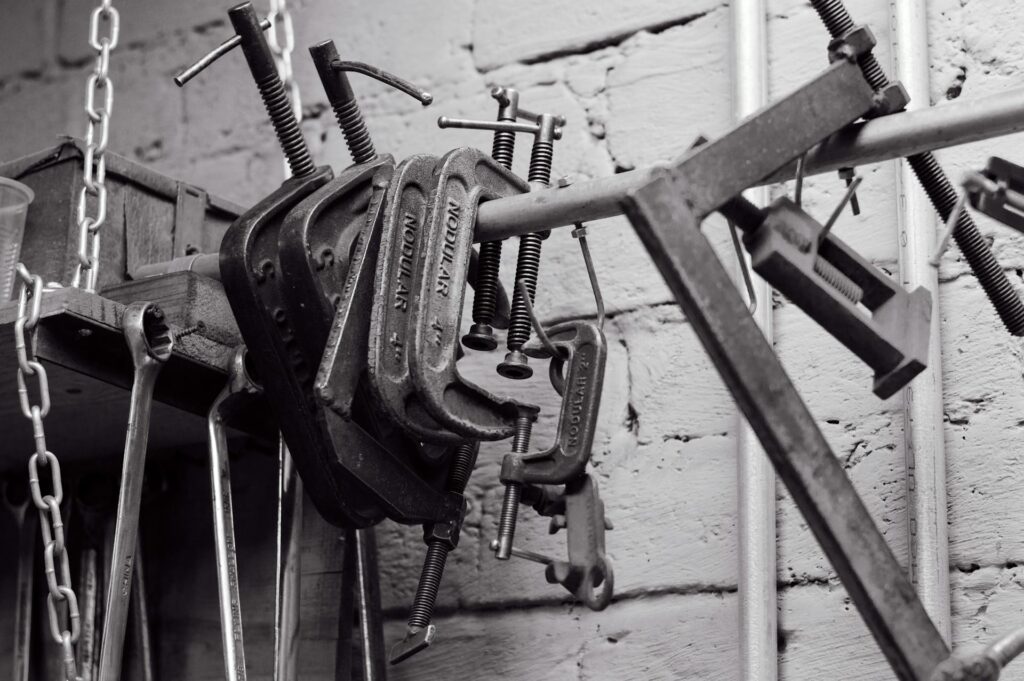
Industrial machines rarely disappear, they simply outlive their technical documentation. Across the world, many shops still operate equipment installed decades ago. The machines themselves remain mechanically sound, but the spare parts that keep them running slowly vanish from supply chains. Drawings are lost, suppliers disappear, and OEM lead times stretch into months. Reverse engineering exists precisely for this situation.
At Tiger Parts, reverse engineering allows us to reconstruct the engineering definition of a component or an assembly when the original documentation no longer exists. Instead of starting from a design file or a drawing, the process begins with the physical object itself. Geometry, materials, manufacturing methods and surface treatments must all be “rediscovered” and translated back into modern engineering specifications.
The goal is straightforward: recreate a part that performs exactly as the original did, and sometimes better. Achieving this goal requires a structured engineering process.
UNDERSTANDING THE PART BEFORE MEASURING
A reverse engineering project always begins with understanding the role of the component within its mechanical environment. Before any measurement takes place, engineers analyze how the part interacts with the surrounding assembly. Load paths, wear patterns, deformation zones, and typical failure mechanisms all provide valuable information about the original design intent. A shaft that appears geometrically simple may actually operate under combined torsion, bending, and fatigue loads. A housing may require dimensional stability under temperature variation. For multi-components parts.
And understanding the customer application is key to succeed there. To ensure reliability and traceability, Tiger Parts focuses exclusively on non-critical components, allowing us to deliver fast, flexible manufacturing solutions without entering the highly regulated certification chain required for safety-critical hardware.
Equally important is identifying the original manufacturing method. Most components carry visible signatures of their production process. Tool marks may indicate CNC machining, while parting lines suggest casting or forging. Surface textures often reveal whether a part was ground, milled, or molded. These details are not cosmetic; they influence tolerances, material properties, and long-term durability.
Recognizing the manufacturing process helps determine how the part should be reproduced. In some cases the original process must be replicated to maintain mechanical properties. In others, different manufacturing technologies allow significant improvements in cost, lead time, or reliability.
The question of volumes expected by the customer also plays a very important role in identifying the best technology to re-produce the parts. Designing and building a mold if only 5 parts are ultimately produced isn’t economically viable. This is where switching to production technologies suited for high-mix, low-volume manufacturing can make a significant impact.
Only once this contextual understanding is established does the reconstruction process begin.
DIMENSIONAL RECONSTRUCTION: CAPTURING GEOMETRY WITH HIGH PRECISION
Recreating geometry is one of the most technically demanding stages of reverse engineering.
At Tiger Parts, dimensional reconstruction relies on a combination of high-resolution 3D scanning, coordinate metrology, and traditional measurement techniques. Each method serves a specific role in capturing the geometry of the component as accurately as possible.
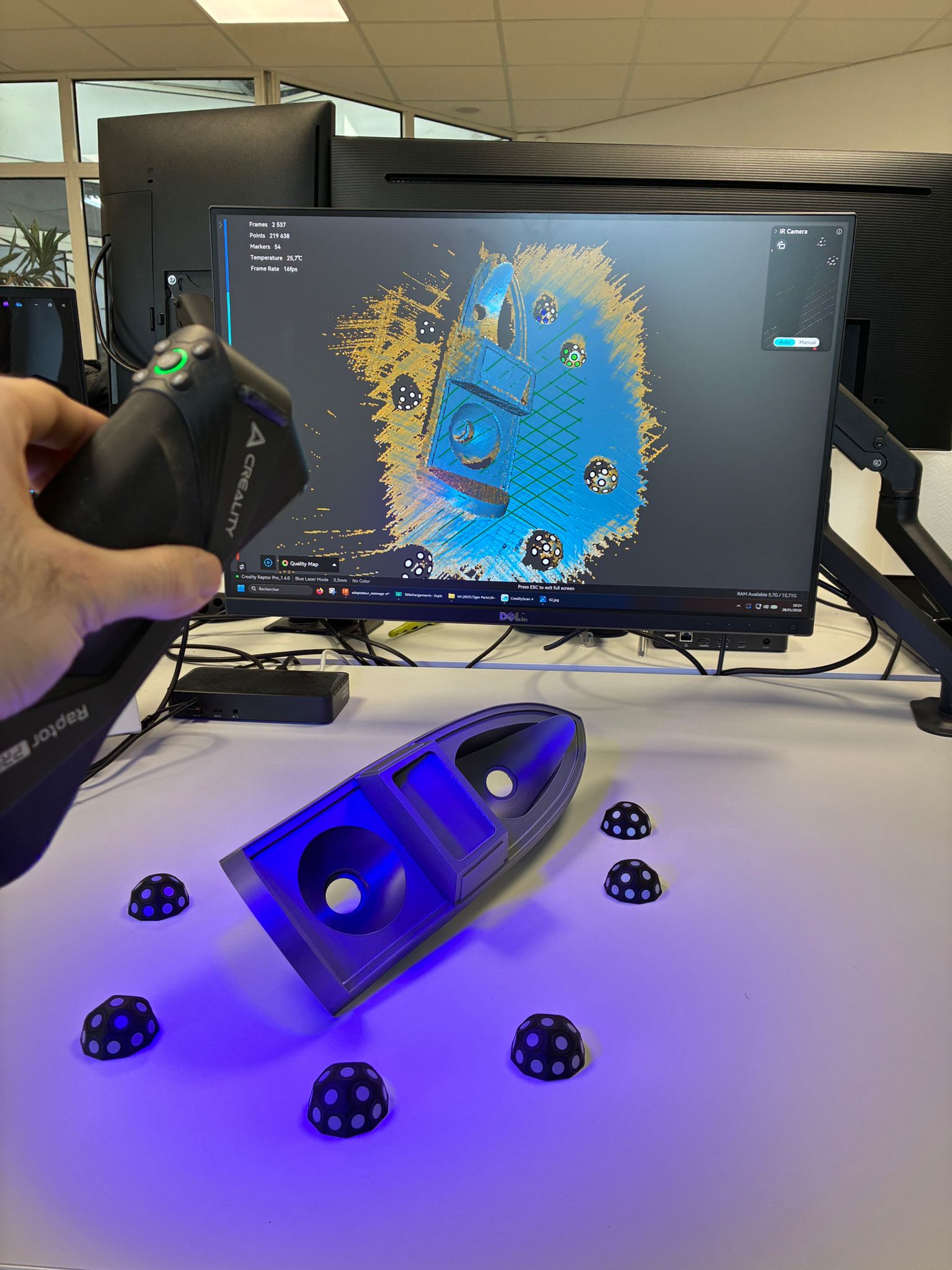
The primary digital acquisition tool in our workflow is the Creality Raptor Pro 3D scanner. This scanner uses a hybrid scanning architecture combining blue laser technology and structured light, allowing it to capture complex geometries with high point density while maintaining excellent dimensional stability.
The Raptor Pro operates with measurement accuracy in the tens-of-microns range, enabling the capture of fine features. Blue laser scanning also performs well on surfaces commonly encountered in industrial components, including metallic finishes, reflective areas, and darker materials.
For people not familiar with the process itself, during scanning, the component is digitized into a dense point cloud representing the complete surface geometry. This data is converted into a polygon mesh, forming the digital basis for reconstruction.
However, scanning alone is never sufficient for precision engineering. Critical functional features must be validated using Coordinate Measuring Machines (CMM). The CMM allows engineers to verify elements such as bearing seats, alignment bores, or precision interfaces with extremely high accuracy. These measurements act as reference constraints during CAD reconstruction.
Traditional metrology tools also remain essential. Precision calipers, micrometers, bore gauges, and thread gauges are used to confirm tolerances and verify dimensions that may require direct measurement.
The combination of 3D scanning, coordinate metrology, and manual measurement ensures that both complex surfaces and critical functional interfaces are reconstructed with confidence.
The final output of this phase is a fully parametric CAD model, representing the digital twin of the original component.
MATERIAL IDENTIFICATION: UNDERSTANDING THE MECHANICAL PROPERTIES TO ENSURE OPTIMAL REDESIGN
Geometry alone does not define a mechanical component. Material composition determines whether a part survives years of operation or fails prematurely in their environment.
When original material specifications are unavailable, identification must be performed through physical analysis.
This typically begins with spectrometric testing, such as Optical Emission Spectroscopy (OES) or X-ray fluorescence. These techniques determine the elemental composition of the alloy, allowing engineers to identify the material grade.
Additional tests may include hardness measurements or microstructural analysis. These investigations reveal whether the component has undergone treatments such as quenching, tempering, carburizing, or nitriding.
Understanding the material is essential not only for reproducing the part but also for evaluating whether improvements are possible. In some cases, modern alloys or treatments offer better wear resistance or corrosion protection than the original design.
The objective remains conservative: ensure the reproduced component performs at least as reliably as the original part within its operating conditions. And this is key to an accurate reverse engineering process.
SURFACE TREATMENT AND FINISHING PROCESSES
Surface engineering often defines the final performance of a component. Many industrial parts rely on treatments that modify the outer layer of the material to improve wear resistance, fatigue life, corrosion protection, or friction behavior. These treatments can include processes such as anodizing, nitriding, galvanization, passivation, or chrome plating.
Identifying these treatments requires careful observation and sometimes laboratory analysis. Surface coloration, hardness gradients, and microscopic structures often reveal how the surface was engineered.
Reproducing these finishing processes is essential. A part may appear geometrically identical, but if its surface treatment differs, its operational lifespan may change dramatically.
Reverse engineering must therefore account not only for geometry and material, but also for the engineering of the surface itself.
RECONSTRUCTING THE TECHNICAL SPECIFICATION
Once geometry, materials, and surface conditions have been characterized, the final stage of reverse engineering consists of rebuilding the technical documentation.
This step translates the reconstructed information into a complete engineering specification. Manufacturing drawings are generated from the CAD model, including dimensional tolerances, surface finish requirements, material standards, and quality control checkpoints. And nothing better than a technical drawing to recap all the important features of a part.
The result is not merely a replacement component. It is a fully defined engineering part that can be manufactured reliably, inspected consistently, and reproduced again in the future. Even if the last piece of information is a “physical” paper print.
In many cases, this stage restores technical knowledge that had effectively disappeared.
TYPICAL REVERSE ENGINEERING TIMELINES
A common concern for repair shops or maintenance teams is how long reverse engineering projects take.
The timeline depends largely on the complexity of the part and the level of analysis required.
| Component Type | Typical Timeline |
| Simple mechanical components | 1 day to 2 weeks |
| Moderately complex assemblies | 1 – 3 weeks |
| High-precision or critical components | 4 – 6 weeks |
These timelines include dimensional reconstruction, CAD modeling, and preparation for manufacturing. Additional laboratory testing can extend the schedule depending on the analyses required.
REVERSE ENGINEERING COSTS AND THE IMPORTANCE OF A TAILORED APPROACH
One of the most frequent questions we receive is how much reverse engineering costs. This question is key to the success of a remanufacturing project, as unit economics have to be taken into consideration for the application considered. If the part is a simple consumable part without strong technical requirements, this can start at 250 € with simple reconstruction. For more complex technical projects, the cost of a reverse engineering project can go up to 2500 €.
The answer depends entirely on the depth of investigation required to reproduce the component reliably. Some parts require only dimensional reconstruction. Others demand full metallurgical and surface analysis.
The table below illustrates typical engineering activities involved in reverse engineering projects.
| Activity | Purpose | Typical Cost Range |
| Initial engineering assessment | Functional analysis and manufacturing process identification | 50€ – €150 |
| Part preparation and inspection | Cleaning, visual inspection, wear and deformation analysis | 150€ – €300 |
| 3D scanning (Creality Raptor Pro) | High-resolution geometry acquisition | 300€ – €700 |
| Mesh processing | Alignment and cleanup of scanning data | 70€ – 150€ |
| CAD reconstruction | Creation of parametric CAD model | 150€ – 300€ |
| CMM dimensional verification | High-precision measurement of critical features | 25€ – 50€ (per feature) |
| Manual metrology | Verification of threads, fits and tolerances | 15€ – 20€ |
| Optical Emission Spectroscopy (OES) | Determination of alloy composition | 350€ – 500€ |
| Hardness testing | Identification of mechanical properties and treatments | 50€ – 150€ |
| Metallographic analysis | Investigation of microstructure and heat treatments | 250€ – 400€ |
| Surface treatment identification | Analysis of coatings and surface processes | 300€ – 450€ |
| Technical drawing creation | Production drawings and specifications | 150€ – 400€ |
Not every project requires all of these activities. The objective is always to apply the appropriate level of engineering analysis for the component and its application.
This approach keeps reverse engineering both technically reliable and economically efficient.
CONCLUSION: REBUILDING THE ENGINEERING BEHIND THE PART
Reverse engineering is sometimes described as copying a component. In reality, it is closer to rediscovering the engineering knowledge embedded inside a physical object.
Every machined surface, alloy selection, and heat treatment tells part of the story of how the component was designed to function and a reflection of design choices that were made long ago. By combining metrology, materials science, and modern manufacturing technologies, reverse engineering allows that knowledge to be reconstructed and translated into a new production-ready design.
For companies operating legacy equipment, this capability often makes the difference between replacing an entire machine or specific components.
If you want to know more about reverse engineering or if you’d like to start a project, book a call with us.