Category: Uncategorized

  • Reverse Engineering industrial parts: rebuilding what Industry has forgotten

    Reverse Engineering industrial parts: rebuilding what Industry has forgotten

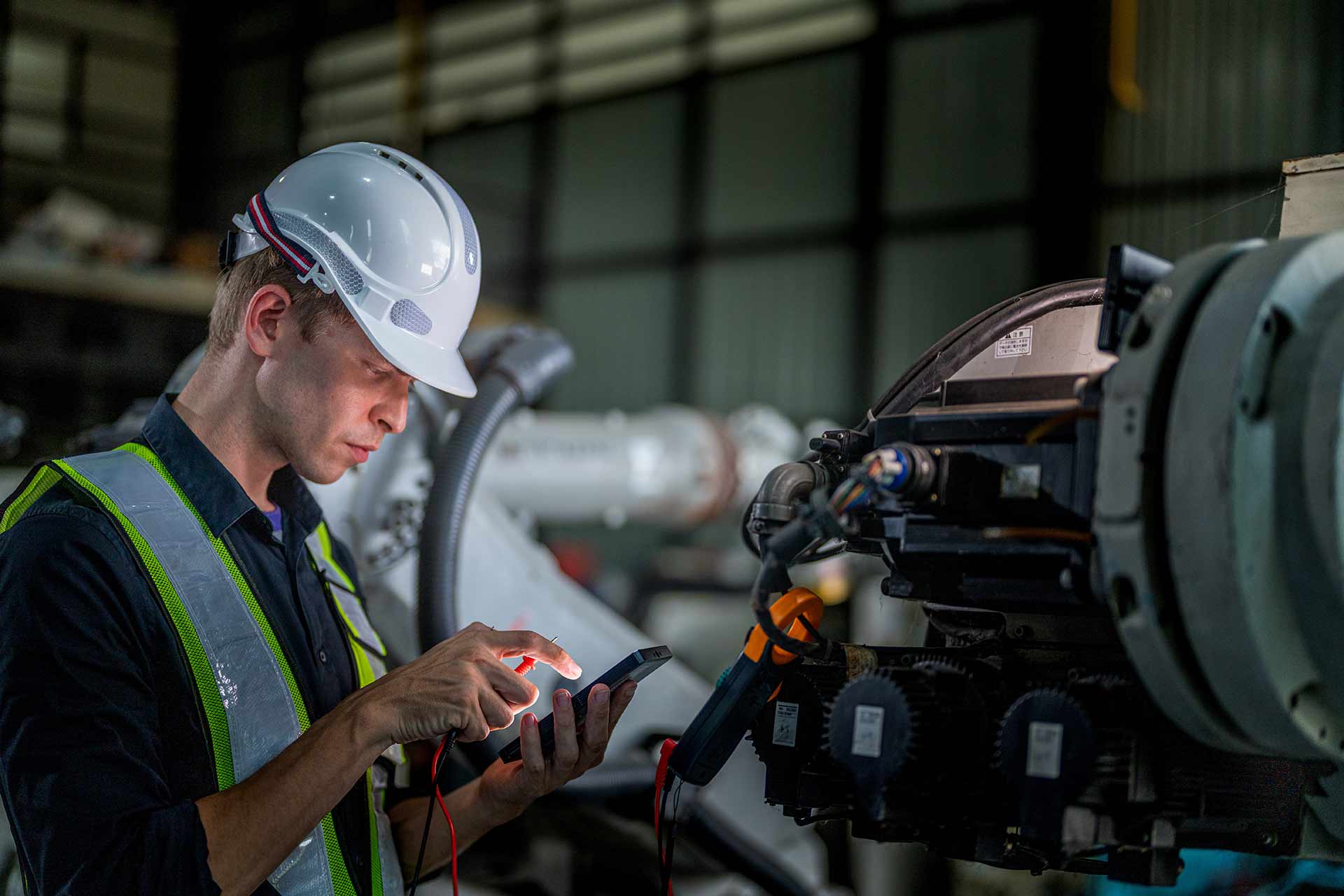
    Industrial machines rarely disappear, they simply outlive their technical documentation. Across the world, many shops still operate equipment installed decades ago. The machines themselves remain mechanically sound, but the spare parts that keep them running slowly vanish from supply chains. Drawings are lost, suppliers disappear, and OEM lead times stretch into months. Reverse engineering exists precisely for this situation.

    At Tiger Parts, reverse engineering allows us to reconstruct the engineering definition of a component or an assembly when the original documentation no longer exists. Instead of starting from a design file or a drawing, the process begins with the physical object itself. Geometry, materials, manufacturing methods and surface treatments must all be “rediscovered” and translated back into modern engineering specifications.

    The goal is straightforward: recreate a part that performs exactly as the original did, and sometimes better. Achieving this goal requires a structured engineering process.

    UNDERSTANDING THE PART BEFORE MEASURING

    A reverse engineering project always begins with understanding the role of the component within its mechanical environment. Before any measurement takes place, engineers analyze how the part interacts with the surrounding assembly. Load paths, wear patterns, deformation zones, and typical failure mechanisms all provide valuable information about the original design intent. A shaft that appears geometrically simple may actually operate under combined torsion, bending, and fatigue loads. A housing may require dimensional stability under temperature variation. For multi-components parts. 

    And understanding the customer application is key to succeed there. To ensure reliability and traceability, Tiger Parts focuses exclusively on non-critical components, allowing us to deliver fast, flexible manufacturing solutions without entering the highly regulated certification chain required for safety-critical hardware.

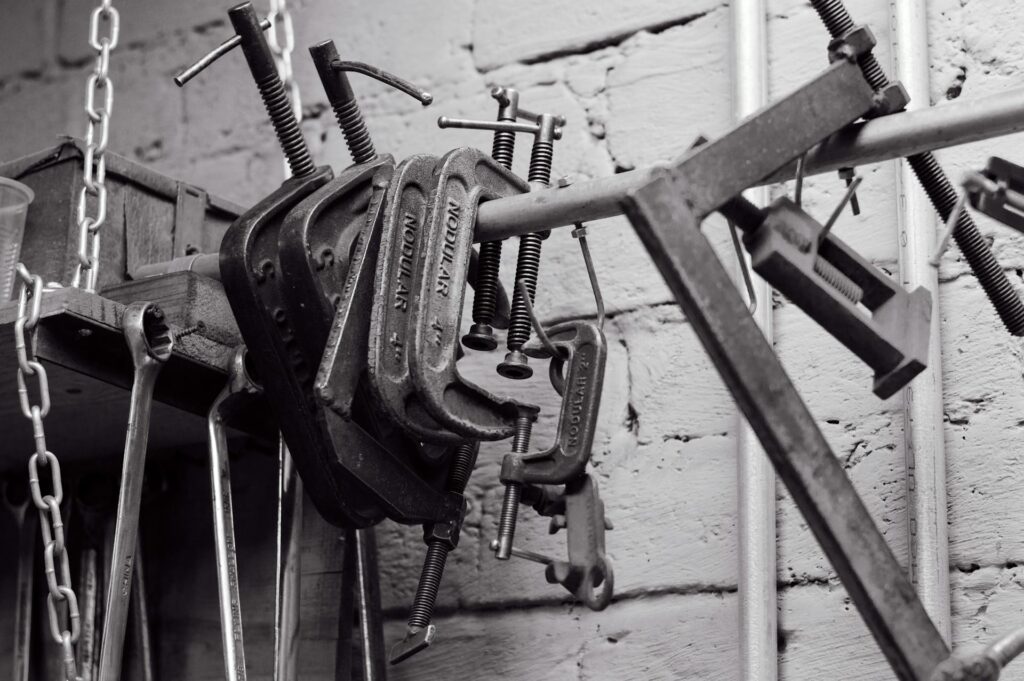
    Equally important is identifying the original manufacturing method. Most components carry visible signatures of their production process. Tool marks may indicate CNC machining, while parting lines suggest casting or forging. Surface textures often reveal whether a part was ground, milled, or molded. These details are not cosmetic; they influence tolerances, material properties, and long-term durability.

    Recognizing the manufacturing process helps determine how the part should be reproduced. In some cases the original process must be replicated to maintain mechanical properties. In others, different manufacturing technologies allow significant improvements in cost, lead time, or reliability. 

    The question of volumes expected by the customer also plays a very important role in identifying the best technology to re-produce the parts. Designing and building a mold if only 5 parts are ultimately produced isn’t economically viable. This is where switching to production technologies suited for high-mix, low-volume manufacturing can make a significant impact.

    Only once this contextual understanding is established does the reconstruction process begin.

    DIMENSIONAL RECONSTRUCTION: CAPTURING GEOMETRY WITH HIGH PRECISION

    Recreating geometry is one of the most technically demanding stages of reverse engineering.

    At Tiger Parts, dimensional reconstruction relies on a combination of high-resolution 3D scanning, coordinate metrology, and traditional measurement techniques. Each method serves a specific role in capturing the geometry of the component as accurately as possible.

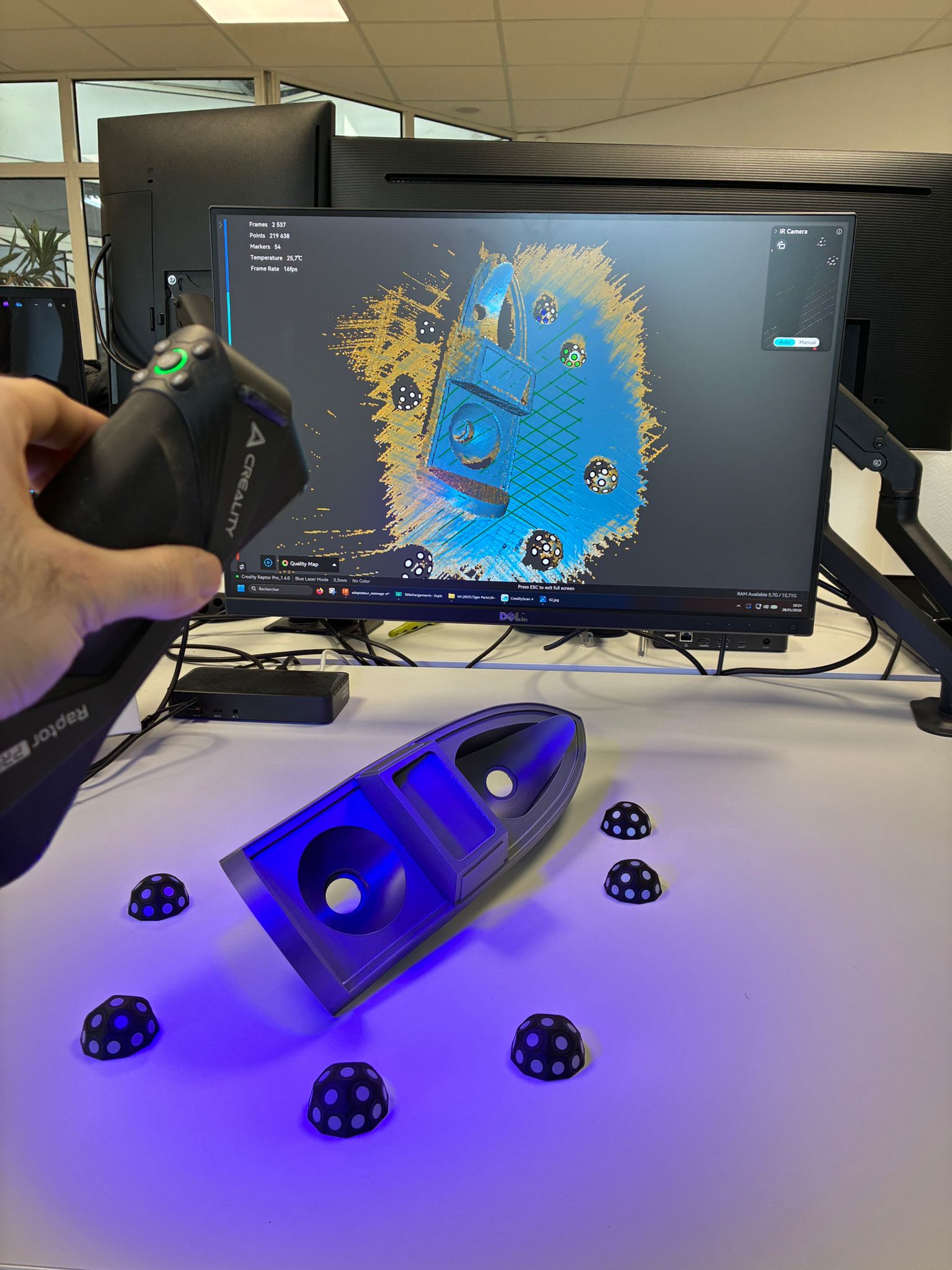
    The primary digital acquisition tool in our workflow is the Creality Raptor Pro 3D scanner. This scanner uses a hybrid scanning architecture combining blue laser technology and structured light, allowing it to capture complex geometries with high point density while maintaining excellent dimensional stability. 

    The Raptor Pro operates with measurement accuracy in the tens-of-microns range, enabling the capture of fine features. Blue laser scanning also performs well on surfaces commonly encountered in industrial components, including metallic finishes, reflective areas, and darker materials. 

    For people not familiar with the process itself, during scanning, the component is digitized into a dense point cloud representing the complete surface geometry. This data is converted into a polygon mesh, forming the digital basis for reconstruction.

    However, scanning alone is never sufficient for precision engineering. Critical functional features must be validated using Coordinate Measuring Machines (CMM). The CMM allows engineers to verify elements such as bearing seats, alignment bores, or precision interfaces with extremely high accuracy. These measurements act as reference constraints during CAD reconstruction.

    Traditional metrology tools also remain essential. Precision calipers, micrometers, bore gauges, and thread gauges are used to confirm tolerances and verify dimensions that may require direct measurement.

    The combination of 3D scanning, coordinate metrology, and manual measurement ensures that both complex surfaces and critical functional interfaces are reconstructed with confidence.

    The final output of this phase is a fully parametric CAD model, representing the digital twin of the original component.

    MATERIAL IDENTIFICATION: UNDERSTANDING THE MECHANICAL PROPERTIES TO ENSURE OPTIMAL REDESIGN

    Geometry alone does not define a mechanical component. Material composition determines whether a part survives years of operation or fails prematurely in their environment. 

    When original material specifications are unavailable, identification must be performed through physical analysis.

    This typically begins with spectrometric testing, such as Optical Emission Spectroscopy (OES) or X-ray fluorescence. These techniques determine the elemental composition of the alloy, allowing engineers to identify the material grade.

    Additional tests may include hardness measurements or microstructural analysis. These investigations reveal whether the component has undergone treatments such as quenching, tempering, carburizing, or nitriding.

    Understanding the material is essential not only for reproducing the part but also for evaluating whether improvements are possible. In some cases, modern alloys or treatments offer better wear resistance or corrosion protection than the original design.

    The objective remains conservative: ensure the reproduced component performs at least as reliably as the original part within its operating conditions. And this is key to an accurate reverse engineering process.

    SURFACE TREATMENT AND FINISHING PROCESSES

    Surface engineering often defines the final performance of a component. Many industrial parts rely on treatments that modify the outer layer of the material to improve wear resistance, fatigue life, corrosion protection, or friction behavior. These treatments can include processes such as anodizing, nitriding, galvanization, passivation, or chrome plating.

    Identifying these treatments requires careful observation and sometimes laboratory analysis. Surface coloration, hardness gradients, and microscopic structures often reveal how the surface was engineered.

    Reproducing these finishing processes is essential. A part may appear geometrically identical, but if its surface treatment differs, its operational lifespan may change dramatically.

    Reverse engineering must therefore account not only for geometry and material, but also for the engineering of the surface itself.

    RECONSTRUCTING THE TECHNICAL SPECIFICATION

    Once geometry, materials, and surface conditions have been characterized, the final stage of reverse engineering consists of rebuilding the technical documentation.

    This step translates the reconstructed information into a complete engineering specification. Manufacturing drawings are generated from the CAD model, including dimensional tolerances, surface finish requirements, material standards, and quality control checkpoints. And nothing better than a technical drawing to recap all the important features of a part. 

    The result is not merely a replacement component. It is a fully defined engineering part that can be manufactured reliably, inspected consistently, and reproduced again in the future. Even if the last piece of information is a “physical” paper print. 

    In many cases, this stage restores technical knowledge that had effectively disappeared.

    TYPICAL REVERSE ENGINEERING TIMELINES

    A common concern for repair shops or maintenance teams is how long reverse engineering projects take.

    The timeline depends largely on the complexity of the part and the level of analysis required.

    Component TypeTypical Timeline
    Simple mechanical components1 day to 2 weeks
    Moderately complex assemblies1 – 3 weeks
    High-precision or critical components4 – 6 weeks

    These timelines include dimensional reconstruction, CAD modeling, and preparation for manufacturing. Additional laboratory testing can extend the schedule depending on the analyses required.

    REVERSE ENGINEERING COSTS AND THE IMPORTANCE OF A TAILORED APPROACH

    One of the most frequent questions we receive is how much reverse engineering costs. This question is key to the success of a remanufacturing project, as unit economics have to be taken into consideration for the application considered. If the part is a simple consumable part without strong technical requirements, this can start at 250 € with simple reconstruction. For more complex technical projects, the cost of a reverse engineering project can go up to 2500 €. 

    The answer depends entirely on the depth of investigation required to reproduce the component reliably. Some parts require only dimensional reconstruction. Others demand full metallurgical and surface analysis.

    The table below illustrates typical engineering activities involved in reverse engineering projects.

    ActivityPurposeTypical Cost Range
    Initial engineering assessmentFunctional analysis and manufacturing process identification50€  – €150
    Part preparation and inspectionCleaning, visual inspection, wear and deformation analysis150€ – €300
    3D scanning (Creality Raptor Pro)High-resolution geometry acquisition300€ – €700
    Mesh processingAlignment and cleanup of scanning data70€ – 150€
    CAD reconstructionCreation of parametric CAD model150€ – 300€
    CMM dimensional verificationHigh-precision measurement of critical features25€ – 50€ (per feature)
    Manual metrologyVerification of threads, fits and tolerances15€ – 20€
    Optical Emission Spectroscopy (OES)Determination of alloy composition350€ – 500€
    Hardness testingIdentification of mechanical properties and treatments50€ – 150€
    Metallographic analysisInvestigation of microstructure and heat treatments250€ – 400€
    Surface treatment identificationAnalysis of coatings and surface processes300€ – 450€
    Technical drawing creationProduction drawings and specifications150€ – 400€

    Not every project requires all of these activities. The objective is always to apply the appropriate level of engineering analysis for the component and its application.

    This approach keeps reverse engineering both technically reliable and economically efficient.

    CONCLUSION: REBUILDING THE ENGINEERING BEHIND THE PART

    Reverse engineering is sometimes described as copying a component. In reality, it is closer to rediscovering the engineering knowledge embedded inside a physical object.

    Every machined surface, alloy selection, and heat treatment tells part of the story of how the component was designed to function and a reflection of design choices that were made long ago. By combining metrology, materials science, and modern manufacturing technologies, reverse engineering allows that knowledge to be reconstructed and translated into a new production-ready design. 

    For companies operating legacy equipment, this capability often makes the difference between replacing an entire machine or specific components.

    If you want to know more about reverse engineering or if you’d like to start a project, book a call with us.  
  • Retrofit & custom manufacturing: a long term relationship

    Retrofit & custom manufacturing: a long term relationship

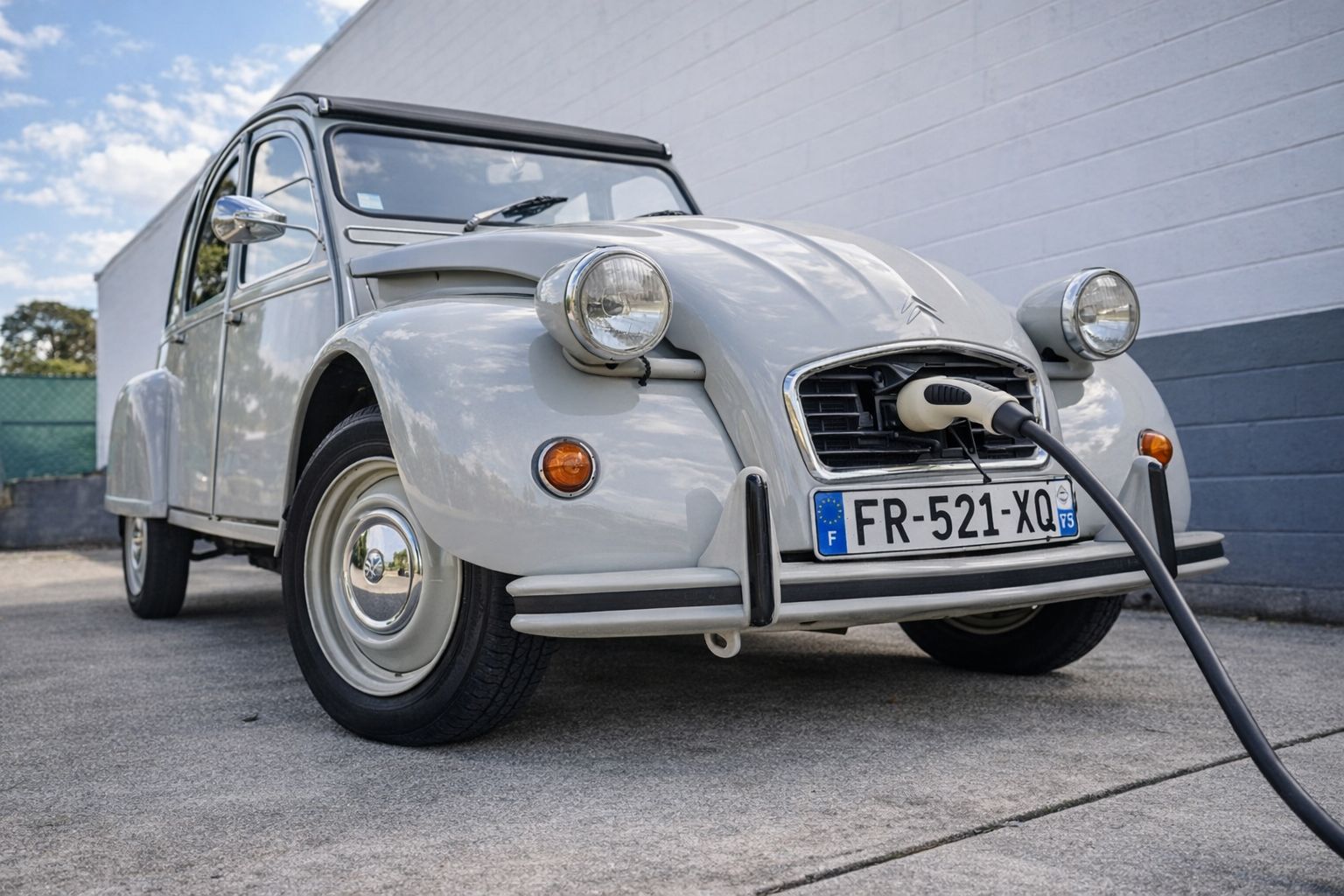
    Original 2CV retrofit with electrical power cord

    Retrofit and custom manufacturing go hand in hand. Retrofit gives a second life to existing machines, vehicles, and industrial systems by replacing obsolete, unavailable, or non-compliant components, without rebuilding everything from scratch. Like some kind of reincarnation, but for material equipment 🙂

    Very quickly, one reality becomes obvious: retrofit is impossible without custom part manufacturing. It’s like renovating an old apartment without cutting planks to specific dimensions….barely impossible!

    Whether we are talking about electric vehicle conversion kits or the modernization of special industrial machines, custom manufacturing,especially CNC machining,is not a nice-to-have. It is the core enabling technology behind every successful retrofit project.

    What is Retrofit?

    Back to basics: retrofit means modernizing an existing system while keeping its main structure intact. Some components are kept while others are dismantled in order to be replaced or renovated. This practice, already very much common in the defense & aerospace sector with the need to maintain planes or vehicles over long periods of time, has become more frequent in the automotive and machinery sectors.

    For cars, the electrification steps are pretty straightforward (and must be done with an existing approved electrification kit):  

    1. replacing the internal combustion engine with an electric powertrain
    2. adapting transmission, mounting points, and braking systems
    3. integrating batteries, power electronics, and cooling systems in the vehicle

    For industrial machines, the idea is very similar: 

    1. replacing obsolete control systems and connected mechanical parts
    2. adapting new sensors, motors actuators and new mechanical components to the existing skeleton
    3. upgrading safety and compliance according to newest standards

    In every single case, retrofit creates a mechanical mismatch between what already exists and what is newly installed. That gap is always closed with custom-made mechanical parts.

    How to do a retrofit?

    A retrofit project always follows the same core logic, regardless of whether it’s a car, a boat, or an industrial machine.

    It starts with an assessment of the existing system: what still works, what must be replaced, and what constraints cannot be changed (geometry, interfaces, regulations). This phase usually involves dismantling, measuring, and documenting parts that were never meant to be reproduced. For most systems, dimensional measurements can be done with a calibrated caliper or 3D scanning systems that we use at Tiger Parts. Most technologies now end up measuring as precisely as 50 microns!

    Then comes the design phase. New components must be adapted to existing ones, which almost always requires reverse engineering. Interfaces are redesigned, loads recalculated, tolerances adjusted, and materials selected to ensure long-term reliability. Very often, some parts can just be re-manufacturing identicallybut some adjustments lead to redesigns…and thus custom manufacturing. 


    Once the design is validated, manufacturing begins. Very often, CNC machining, Multi Jet Fusion or SLS technologies are used to produce adapters, mounts, housings, and structural parts with the precision required to safely integrate old and new components. Some of the parts that need precise fitting also need to be inspected dimensionally after production. Final assembly, fitting, and functional testing close the loop.

    Why are custom parts a must have?

    At the beginning of a retrofit project, the assumption is often “we’ll find a standard adapter.” but reality usually looks like this:

    • hole patterns don’t match
    • shaft heights are off
    • mechanical loads are different
    • OEM parts are obsolete, discontinued, or overpriced

    The result is often that new mechanical interfaces must be created, mounts redesigned and some components remanufactured. This is where the combination of reverse engineering and custom part manufacturing becomes essential.


    Retrofit is not a linear process. Iterations are normal. Small adjustments during assembly are expected. This is exactly why flexible, on-demand custom manufacturing is so critical to the success of retrofit projects.

    Pricing for a retrofit

    Retrofit pricing is often perceived as unpredictable, but in reality, costs follow a clear structure.

    The main cost drivers are:
    – engineering and reverse engineering time
    – number of custom parts required
    – material selection and machining complexity
    – certification, testing, and compliance upgrades

    Custom parts are not expensive because they are custom. Especially if the retrofit applies to a fleet of vehicles or a series of similar machines. In that context, fixed costs can easily get absorbed.

    Compared to full replacement, retrofit remains highly cost-effective. Extending the life of an existing system avoids structural rebuilds, long qualification phases, and massive capital expenses. In many cases, retrofit is the only economically viable option to stay compliant, operational, and competitive.

    Cost CategoryWhat It CoversTypical Cost Range (€)Notes / Cost Drivers
    Electric MotorTraction motor, mounting adapters2,000 – 4,000Power level (50–150 kW), cooling, motor type (AC induction vs PMSM)
    Motor Controller / InverterPower electronics & control unit1,500 – 3,000Automotive-grade components raise cost
    Battery PackCells, casing, BMS, cabling5,000 – 8,000Capacity (20–40 kWh), chemistry (LFP cheaper than NMC)
    Onboard ChargerAC charging module800 – 1,500Single vs three-phase
    DC-DC ConverterHigh → low voltage (12V)400 – 800Required for vehicle electronics
    Cooling System AdaptationPumps, hoses, radiators500 – 1,200Often underestimated
    Wiring & Safety ComponentsHV cables, fuses, contactors600 – 1,200Mandatory for compliance
    Subtotal – Hardware (Certified Kit)12,000 – 18,000Matches market prices you mentioned

    For car renovation, certified electric conversion kits can now be found for around 10 000 €, which makes it a pretty affordable option when you want to drive electric in an old classic car. You also need to include your budget installation fees that vary from 800 € and 2500 € depending on the model. 

    If you decide to create your own kit, be careful with the certification costs that also add to the whole project costs. More formal homologation fees (e.g., UTAC fees in France) specifically for conversions can range from roughly €1,500 – €3,000 depending on complexity and technical documentation requirements.

    How Tiger Parts can help you with your retrofit projects

    At Tiger Parts, retrofit is not an exception. It’s the core use case we build our services for.

    We help retrofit projects by providing:
    – fast reverse engineering from physical parts
    – production-ready CAD adapted to real-world constraints
    – CNC machining or 3D printing for one-off, small, and medium series parts
    – access to a distributed network of qualified manufacturing partners
    – consistent quality and documentation

    Whether you need a single adapter plate or a full set of custom mechanical interfaces, we make sure parts are manufacturable, delivered fast, and fit right the first time.

    Retrofit is about extending value instead of replacing everything. We help you make that extension possible without too much hassle. 

    Conclusion: Retrofit only works if parts fit reality

    Retrofit is never theoretical. It deals with worn interfaces, undocumented geometries, discontinued OEM parts, and real mechanical constraints. Off-the-shelf solutions almost never fit. Custom-manufactured parts are what make the connection between old systems and new technologies possible.

    When done right, retrofit extends asset lifetime, reduces capital expenditure, and dramatically lowers environmental impact. But it only works when mechanical reality is respected.

    Ready to start your retrofit project?

    If you are facing obsolete parts, mismatched interfaces, or a modernization project that cannot rely on catalog components, Tiger Parts can support you,from reverse engineering to CNC machining.

    Contact us !

  • How Caterpillar Became a Global Leader in Circular Maintenance and Refurbishment

    How Caterpillar Became a Global Leader in Circular Maintenance and Refurbishment

    In an era where planned obsolescence dominates too many industrial supply chains, Caterpillar has become a global benchmark for circular economy leadership. While many OEMs still focus on selling new equipment, Caterpillar has built a business model where refurbishment, remanufacturing, and predictive maintenance are not just add-ons – they’re core revenue streams.

    A 50 year head start in remanufacturing

    Caterpillar didn’t wait for sustainability trends or carbon taxes to take action. Since the 1970s, the company has operated its Cat Reman program, which reclaims used components – engines, transmissions, hydraulics – and restores them to “same-as-new” condition with updated engineering specs.

    In 2023 alone, Caterpillar processed more than 125,000 tonnes of end-of-life parts, avoiding the mining, casting, and machining of virgin materials. The company now boasts 18 global remanufacturing facilities, from Indiana to Shanghai.

    According to L’Usine Nouvelle, “Caterpillar’s remanufacturing line in Grimbergen, Belgium, operates at over 90% recovery rate for heavy-duty engine blocks and crankshafts.” That’s a level of industrial circularity that most competitors can only dream of.

    The Economics: A Win-Win-Win

    Caterpillar’s circular model isn’t just green – it’s profitable. The Cat Reman parts are typically 30-50% less expensive than new ones, while carrying the same warranty and performance standards. Customers benefit from lower total cost of ownership (TCO), Caterpillar earns recurring service revenue, and the environment is spared CO₂ emissions and material waste.

    “We’re able to sell the same piece of metal three, four, sometimes five times over its lifecycle,” said Steve Fisher, Vice President of Remanufacturing Division at Caterpillar, in a 2022 Bloomberg interview. “That’s good for business, and it’s good for the planet.”

    A remanufactured engine block, for example, avoids up to 85% of energy consumption and 65% of CO₂ emissions compared to a newly cast block, according to internal data shared by Cat Reman.

    Predictive Maintenance: data driven longevity

    But refurbishment is only part of the equation. Caterpillar has also embraced predictive maintenance through its Cat Connect digital ecosystem. Hundreds of sensors embedded in machinery stream real-time data to the cloud, allowing operators to monitor performance, flag anomalies, and schedule service proactively.

    This data is processed through Cat’s own AI models, developed in collaboration with SAP and Uptake, to predict failures before they occur. The result? Fewer breakdowns, longer uptime, and optimized spare parts usage.

    “With our fleet analytics, we know when a fuel injector is going to fail before the operator feels it,” said Alison Green, Senior Product Manager at Cat Digital. “That allows us to ship the right refurbished part, just in time, from the closest warehouse.”

    This not only reduces downtime – it also enables a parts-on-demand strategy that lowers inventory costs and waste.

    Designing for Circularity

    Caterpillar’s machines are designed to be disassembled and reassembled, often multiple times throughout their lifecycle. Each component carries a serialized ID, and parts are engineered with standardized interfaces and tolerances, making them easier to refurbish and reuse.

    This approach aligns closely with the EU’s expanding Right to Repair framework and anticipated North American regulatory shifts.

    Moreover, Caterpillar has taken steps to support customer-led refurbishment through technical manuals, certified training programs, and the availability of 3D models via its online parts.cat.com platform.

    Customer Case Study: Gold Mine in Chile

    In 2022, a major gold mining operation in Chile partnered with Caterpillar for a full remanufacturing and predictive maintenance program on their fleet of Cat 793 haul trucks. Over 12 months, the mine reported:\n- $3.1 million saved in maintenance costs\n- 22% increase in uptime\n- Nearly 400 tonnes of steel saved via remanufactured components

    “Our haul trucks now run longer, cost less, and come with stronger data to make decisions,” said the site maintenance director in a case study published on Caterpillar’s own website. “We never imagined refurbished parts could outperform brand new ones.”

    A Blueprint for the Circular Industrial Economy

    While other OEMs still treat spare parts as an afterthought – or worse, as a profit trap – Caterpillar treats its aftersales business as a strategic lever. Its long-term thinking, heavy investment in digital platforms, and customer-centric circular design make it an industry pioneer.

    In fact, in 2024 Caterpillar was awarded a “Top 10 Circular Industrial Leader” title by the World Economic Forum, alongside companies like Schneider Electric and Siemens.

    Conclusion: Lessons from the Cat Playbook

    Caterpillar’s success proves that a circular economy isn’t just about recycling. It’s about:

    • Designing equipment for repairability
    • Building global networks for remanufacturing
    • Using data to drive predictive maintenance
    • Creating value for customers, not just shareholders

    As the climate crisis intensifies and industrial procurement grows more volatile, manufacturers looking to thrive in the coming decades would do well to study Caterpillar’s model – not as a niche, but as a roadmap.